
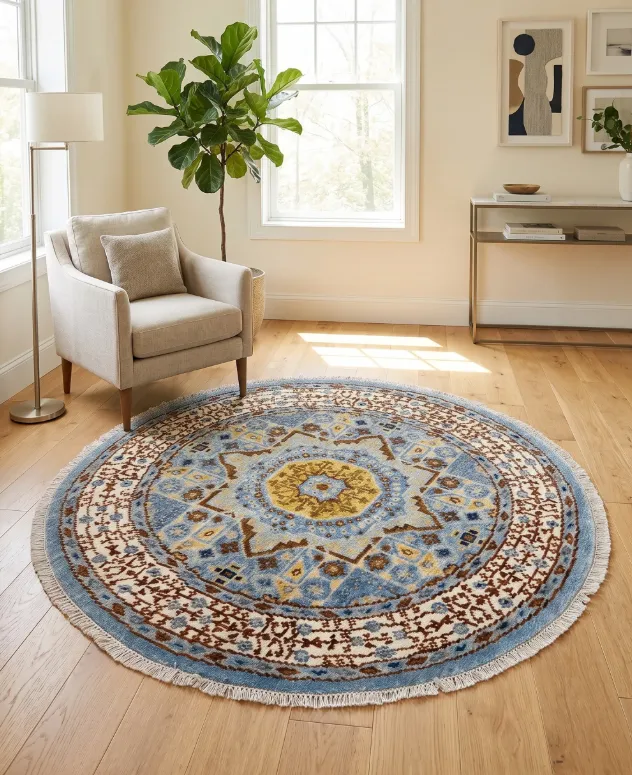
Let’s start with the uncomfortable part. Hand knotted wool rugs are expensive. Sometimes very expensive. And the rug industry often gives buyers the laziest explanation possible: “It is handmade, so it costs more.”
That is true, but it is not enough.
A hand knotted wool rug costs more because it is built differently from the ground up. Individual yarn knots are tied around the foundation on a loom, row after row, instead of yarn simply being pushed into a backing and held together with adhesive. This is why genuine hand-knotted rugs can take weeks or months to produce and why their construction can remain relevant for decades when properly cared for.
But here is the bigger point: You should not buy a hand knotted wool rug because someone told you it is “luxury”. You should buy one only if its long-term construction actually makes sense for how you live.
For a temporary home or a room you redecorate every two years? Probably unnecessary.
For a home where you want one serious designer hand knotted rug that can stay for decades? The conversation changes completely.
Why Are Hand Knotted Wool Rugs So Much More Expensive?
The price comes mainly from skilled labour, production time, knot density, materials and the complexity of the design, not from the word “handmade” alone. Two wool rugs can look nearly identical from across a room and still have completely different construction. One may be hand tufted. The other may be genuinely hand knotted. That difference matters.
In a hand knotted wool rug:
- Each knot is tied individually on a loom.
- The design is built into the rug as it is made.
- There is no latex layer holding the pile in place.
- The back reflects the structure of the knots.
- Production can take weeks or months, depending on size and complexity.
The Carpet Export Promotion Council explains that higher knot density generally allows greater intricacy and design clarity, although it also increases the labour involved and therefore the price.
This is why price can vary dramatically:
- Size: More surface means more knots and more labour.
- Knot density: Finer rugs can take substantially longer.
- Design complexity: Curves and detailed motifs demand more precise work.
- Wool quality: Not all wool behaves or performs the same.
- Finishing: Washing, trimming, and edge finishing also affect the final piece.
You are not paying for one product label. You are paying for thousands or millions of individual decisions made during construction.
That is the real reason a genuine hand knotted rug cannot be compared directly with a mass-produced alternative simply because both are made of wool.
Does a Higher Knot Count Mean a Better Hand Knotted Wool Rug?
No. A higher knot count usually means finer detail, but it does not automatically mean the rug is better, more beautiful, or more suitable for your home. This is one of the biggest misconceptions in the premium rug market. Buyers see a larger number and assume: More knots = better rug.
Not always.
Knot density tells you how closely the individual knots are packed. A higher density can allow smoother curves and more intricate patterns. A lower density can suit bold, geometric or more graphic designs perfectly well.
Higher knot density can be useful for:
- Fine floral details.
- Delicate curves.
- Complex artwork.
- Highly intricate traditional patterns.
Medium or lower density can work beautifully for:
- Modern designs.
- Geometric patterns.
- Bold shapes.
- Textured surfaces.
- More relaxed handmade aesthetics.
The important thing is the relationship between the design and the construction. A bold modern design does not need an extremely high knot count to be good. Paying for unnecessary fineness can simply mean paying for detail you do not need.
Wool quality, yarn, dyes, design, weaving consistency, and finishing matter too. So if a seller talks only about KPSI and nothing else, ask more questions.
Are Hand Knotted Wool Rugs Actually Better for Daily Use?
They can be excellent for daily use, but “hand knotted” is not a magic word that makes every rug indestructible. Material, pile height, and where you use it still matter.
This is where rug marketing becomes a little too dramatic.
A hand knotted wool rug can be highly durable because the individual knots are part of the rug’s structure. Wool itself is also naturally resilient and has long been valued for durability and its ability to resist everyday soiling.
They can work well in:
- Living rooms.
- Family rooms.
- Bedrooms.
- Formal sitting areas.
- Other spaces where you want long-term performance.
But consider the complete specification. A thick, delicate wool rug may not be the best choice for the busiest entry passage. A lower or medium pile hand knotted wool rug may be more practical there.
For heavy-use spaces, check:
- Pile height.
- Wool type.
- Density.
- Overall construction.
- Ease of cleaning.
- Whether the design is forgiving between cleanings.
Hand knotted tells you how the rug is constructed. It does not tell you everything about how you should use it. That distinction saves buyers from paying a premium for the wrong rug.
How Can You Tell If a Wool Rug Is Really Hand Knotted?
Turn the rug over. The back is usually more honest than the front. A genuine hand knotted rug should show the underlying pattern and individual knot structure on the reverse rather than a uniform layer of latex or fabric backing. Small irregularities can also be part of genuine handwork.
Check these things:
1. Look at the back
The pattern should generally be visible through the knot structure.
2. Look for individual knots
A hand knotted rug is made knot by knot, not by yarn punched into a backing.
3. Check the fringe carefully
In many hand-knotted rugs, the fringe is part of the structural warp rather than an added decorative strip.
4. Ask what the rug is made from
“Handmade” does not automatically mean hand knotted.
5. Ask about construction, not just origin
Where the rug was made can be meaningful, but construction should be clearly explained.
Be careful with vague descriptions such as:
- Handmade.
- Artisan made.
- Hand finished.
- Handcrafted.
All of these can describe different production methods. The word you need to verify is not “handmade”. It is “hand knotted”. And a seller should be able to explain exactly what that means.